







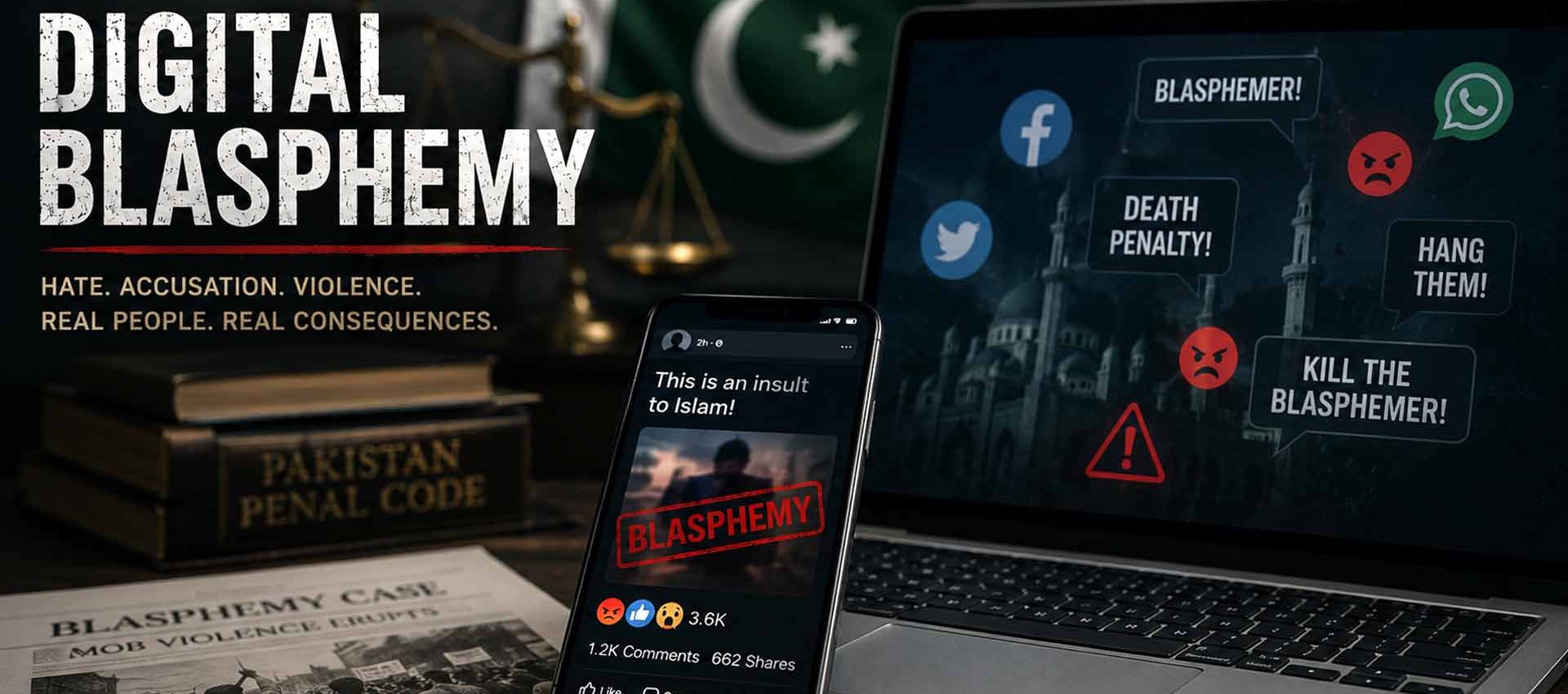
Digital blasphemy in Pakistan has transformed how accusations arise, spread and become evidence in criminal proceedings.
Pakistan’s blasphemy controversy has entered the smartphone era.
Increasingly, allegations involve:
Facebook posts,
WhatsApp messages,
TikTok or other social-media content,
photographs,
screenshots,
SIM cards,
and forwarded digital material.
The technology is new.
The potential punishment remains extraordinarily severe.
Junaid Hafeez
University lecturer Junaid Hafeez was arrested in 2013 following allegations involving online expression.
His prosecution became internationally known.
He was eventually sentenced to death.
His lawyer Rashid Rehman was murdered while representing him.
Taimoor Raza
Taimoor Raza received a death sentence in 2017 following allegations involving digital religious expression.
His case demonstrated that words typed into an electronic device could carry consequences comparable to allegations involving spoken words.
The Screenshot Problem
Digital evidence often looks definitive.
But a screenshot does not necessarily prove authorship.
Investigators must determine:
Who controlled the account?
Who possessed the device?
Could the account have been compromised?
Was the material forwarded?
Was an image manipulated?
Does metadata support the allegation?
Was the SIM actually being used by the person in whose name it was registered?
The Speed of Digital Accusation
There is another problem.
Digital evidence can spread faster than investigators can verify it.
A screenshot may travel through hundreds of phones.
The accused person’s photograph may accompany it.
By the time forensic experts determine whether the material is genuine, thousands of people may already believe the allegation.
New Allegations of Entrapment
More recent cases have produced serious allegations that organised networks may have entrapped or blackmailed people using online communications.
Pakistani institutions have themselves begun examining allegations of organised misuse.
This makes independent digital forensic analysis increasingly important.
Conclusion
The internet has not merely moved blasphemy accusations online.
It has changed their speed, scale and evidentiary complexity.
Where someone’s liberty—or life—may depend upon a message displayed on a telephone, investigators must establish far more than:
“Here is a screenshot.”
They must establish who actually created it.
Read in Dutch | German | Italian | Portuguese