






The Meaning of the White in Pakistan’s National Flag
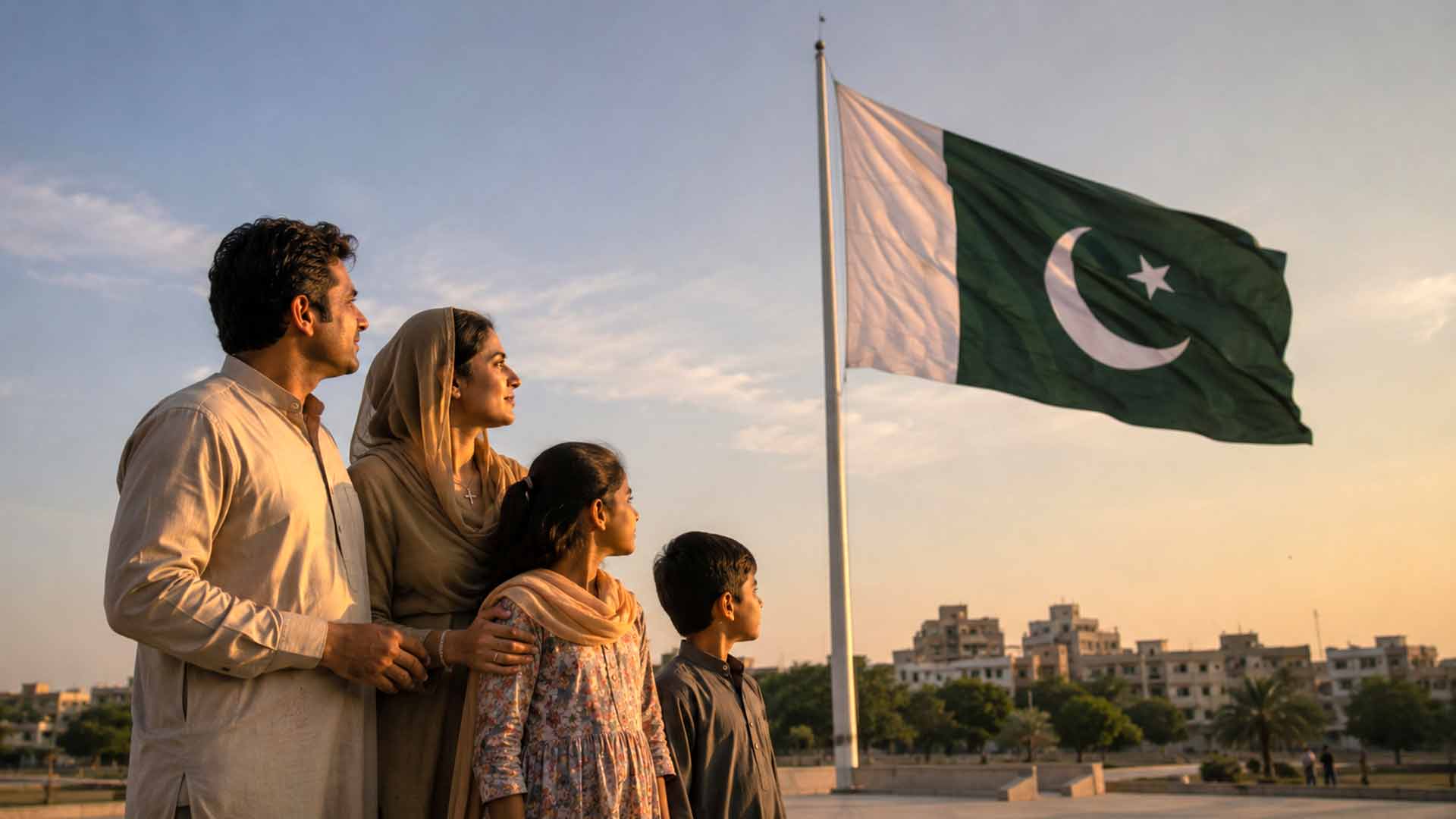
Every year on 14 August, Pakistan’s national flag appears everywhere.
It flies from government buildings.
It hangs from balconies.
Children carry it through streets.
Cars, shops and homes are decorated in green and white.
The crescent and star are instantly recognised.
But one part of the flag deserves a question that Pakistan has perhaps never answered fully:
What does the white stripe mean?
Official Pakistani descriptions of the national flag state that the dark green represents Islam and Pakistan’s Muslim majority, while the vertical white stripe represents the country’s religious minorities living alongside the Muslim majority. The crescent represents progress and the star represents light and knowledge.
The white stripe is therefore not merely decoration.
It represents people.
Christians.
Hindus.
Sikhs.
Parsis and Zoroastrians.
And other non-Muslim citizens of Pakistan.
When the national flag was adopted in August 1947, minorities were deliberately given a visible place within the symbol of the new country.
Nearly eight decades later, however, a difficult question remains:
Has Pakistan honoured what that white stripe represents?
The Flag Was Adopted Before Pakistan Was Even Born
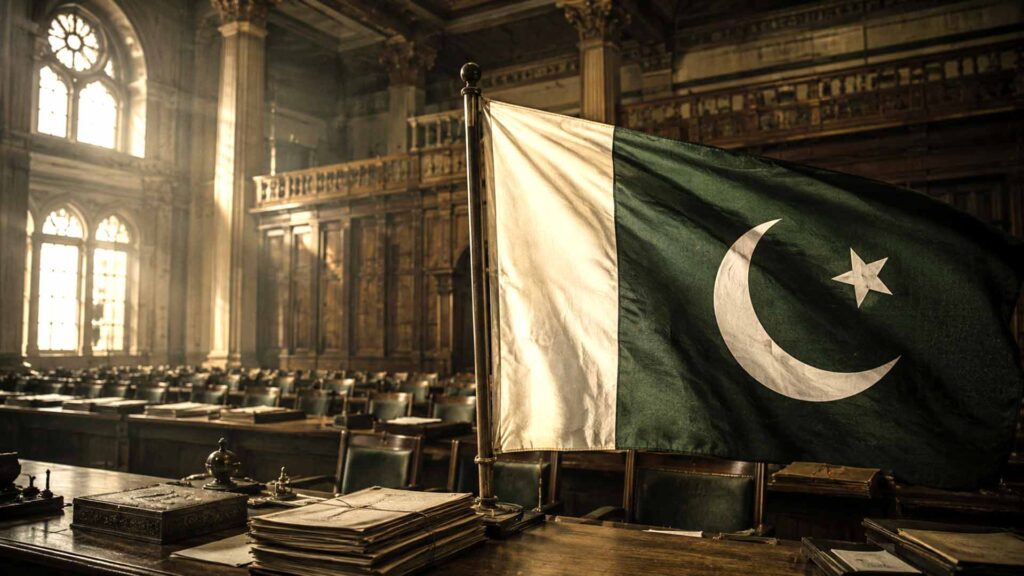
Pakistan’s national flag was formally adopted by the Constituent Assembly on 11 August 1947, three days before independence.
The design was based substantially on the flag associated with the All-India Muslim League, but the new national flag contained an important addition:
a vertical white portion at the hoist.
The design of Pakistan’s flag is generally credited to Syed Amir-uddin Kidwai, based on the Muslim League flag, although the historical record also shows that the final design emerged through the political leadership preparing the new state. Liaquat Ali Khan formally presented the flag resolution to the Constituent Assembly and explained its meaning during the debate.
The official proportions were precise.
One quarter of the flag would be white.
The remaining three quarters would be dark green.
That one-quarter white section carried enormous symbolic importance.
Liaquat Ali Khan Explained What the White Represented
During the Constituent Assembly debate on 11 August 1947, Liaquat Ali Khan addressed concerns from minority representatives about the proposed national flag.
The historical parliamentary record shows that he explained that Pakistan’s flag was not simply the Muslim League flag.
The white portion deliberately made space for minorities.
More remarkably, Liaquat argued that it provided representation not merely for the minority communities then existing in Pakistan but also for other minorities that might exist in the future.
This tells us something important.
The white stripe was not an accidental design choice added simply to make the flag visually attractive.
It was political symbolism.
Pakistan was going to be a Muslim-majority country.
The green acknowledged that reality.
But Pakistan would not contain Muslims alone.
The white acknowledged them too.
In visual terms, the national flag was saying:
The majority belongs here.
And the minorities belong here too.
The Date Makes the Symbolism Even More Powerful
The flag was adopted on 11 August 1947.
That date carries another extraordinary significance.
On the same day, Muhammad Ali Jinnah delivered his famous address to Pakistan’s Constituent Assembly.
Jinnah spoke about law and order, corruption, religious freedom and citizenship.
Pakistan’s National Assembly preserves his address and records his principle that Pakistan was beginning with the understanding that its people were “all citizens and equal citizens of one State.”
He also told citizens that their religion, caste or creed should not determine their political citizenship.
Whatever later historical debates have arisen over precisely how Jinnah envisioned the relationship between Islam and the Pakistani state, one aspect of that speech is extremely difficult to misunderstand:
citizenship was not supposed to make a Christian less Pakistani than a Muslim.
And so, on the same date in August 1947, Pakistan received two powerful symbols of minority inclusion:
Jinnah’s language of equal citizenship,
and
the white stripe in Pakistan’s national flag.
One was spoken.
The other was sewn into the national symbol. Together they represented a promise.
What Was the Promise?
The flag itself obviously does not constitute a legal contract.
But national symbols express national ideals.
If the green represents Pakistan’s Muslim majority while the white represents religious minorities living alongside them, the implied ideal is coexistence.
The white stripe can therefore reasonably be understood as representing:
belonging,
recognition,
protection,
religious diversity,
and above all,
equal citizenship.
Pakistan’s own government continues to describe the white bar as representing religious minorities living side by side with Muslims.
The symbol has never officially disappeared.
The question is whether its meaning has been reflected in reality.
The Constitution Promises Equality—But Also Creates Religious Distinctions
Pakistan’s constitutional framework contains protections for religious freedom and equality.
Yet over the decades, Pakistan has also developed laws and constitutional structures that distinguish citizens on the basis of religion.
This is one of the first places where the promise represented by the white stripe becomes complicated.
For example, as discussed elsewhere in this research series, a non-Muslim Pakistani citizen cannot currently become President or Prime Minister of Pakistan because the Constitution reserves those offices for Muslims.
That means a Pakistani Christian can:
vote,
serve in parliament,
pay taxes,
serve the country,
participate in politics,
and help elect the Prime Minister—
but cannot become Prime Minister.
The white stripe says the Christian belongs to Pakistan.
The Constitution nevertheless places a religious ceiling over how far that Christian can rise politically.
That does not erase every constitutional protection minorities receive.
But it raises a legitimate question about the meaning of equal citizenship.
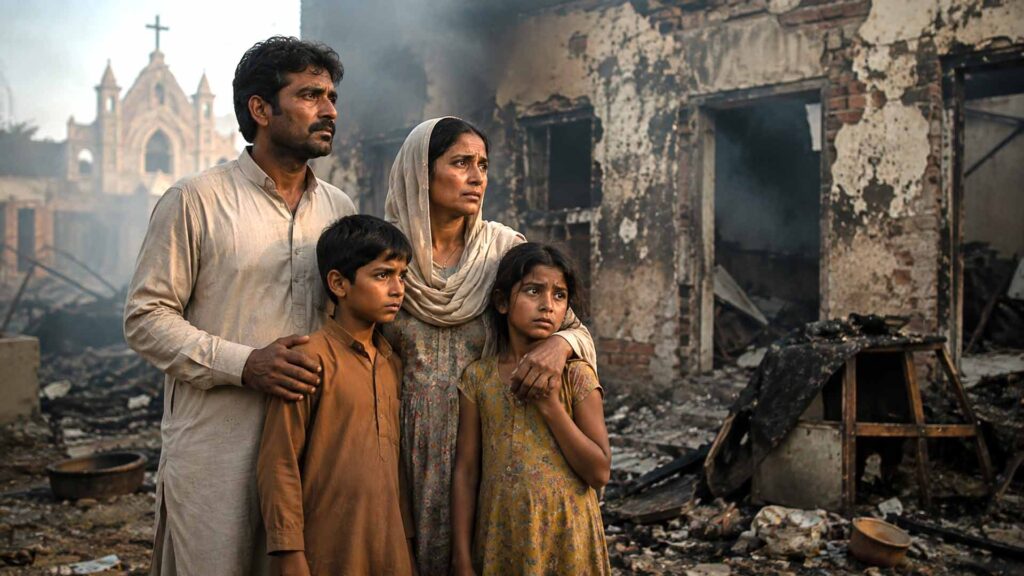
Blasphemy Laws and the Fear of an Accusation
Perhaps no issue illustrates minority insecurity more powerfully than Pakistan’s blasphemy laws.
Christians are not the only victims.
Muslims, Ahmadis, Hindus and others have also been accused.
But Christian communities have repeatedly suffered consequences extending far beyond individual defendants.
Human Rights Watch has documented how a simple accusation of blasphemy can expose an individual to serious physical danger and can lead to attacks against entire minority communities.
Pakistan’s Penal Code contains severe religious-offence provisions, including Section 295-C.
In practice, an allegation itself can become dangerous before any court determines whether it is true.
For a Christian citizen represented by the white stripe, this raises a disturbing contradiction.
The national flag says:
You belong.
But an accusation shouted in a neighbourhood may suddenly force that person to run for their life.
Joseph Colony: When an Entire Christian Community Paid for One Accusation
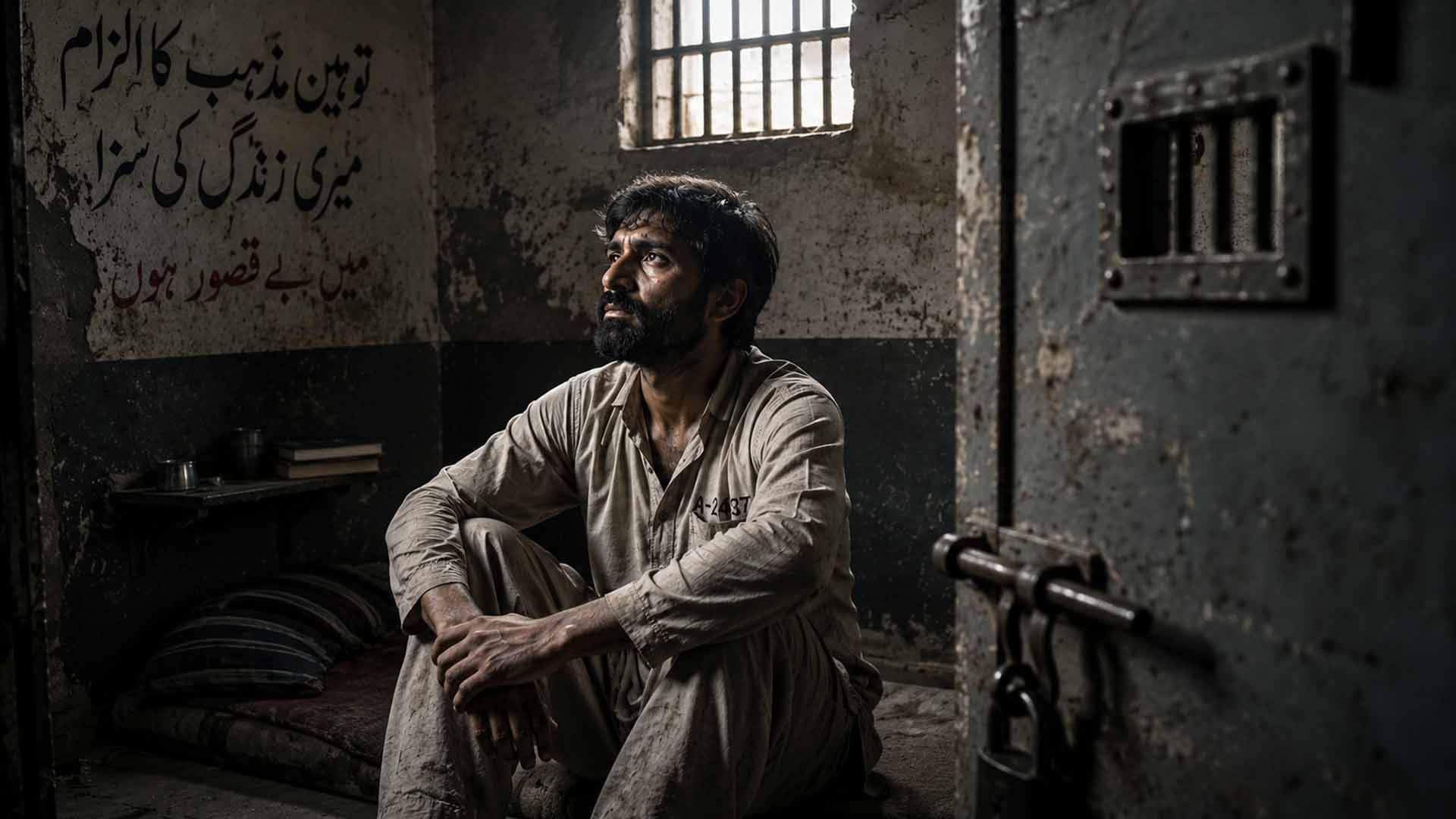
In March 2013, a Christian man in Lahore was accused of blasphemy.
The consequences did not remain confined to the accused.
A large crowd descended on Joseph Colony, a Christian neighbourhood.
Human Rights Watch reported that more than 150 homes were looted and burned as police failed adequately to intervene.
The residents whose houses burned were not defendants in the alleged blasphemy case.
They had not been accused individually.
Their connection to the controversy was their religious identity.
They were Christians.
Citizens represented by the white in Pakistan’s flag.
When an entire neighbourhood can be punished because one member of its religion is accused of an offence, equal citizenship becomes difficult to reconcile with lived reality.
Jaranwala: The White Stripe in Flames
Ten years later, another major attack raised the same question.
On 16 August 2023, blasphemy allegations against Christians in Jaranwala triggered large-scale mob violence.
Churches were attacked.
Christian homes were damaged.
Families fled.
Human Rights Watch described the incident as another example of Pakistan’s failure adequately to protect religious minorities from violence triggered by blasphemy allegations.
Pakistan’s National Commission for Human Rights later investigated Jaranwala itself. Its findings placed the attack within a wider pattern of economic and social disadvantage affecting religious minorities, particularly Christians.
The symbolism is difficult to ignore.
Christians are permanently represented in white on Pakistan’s national flag.
Yet Christian families have repeatedly had to run from their homes inside the country represented by that flag.
Employment: When Christianity Determines the Job You Are Expected to Do
Discrimination does not always involve violence.
Sometimes it appears in employment.
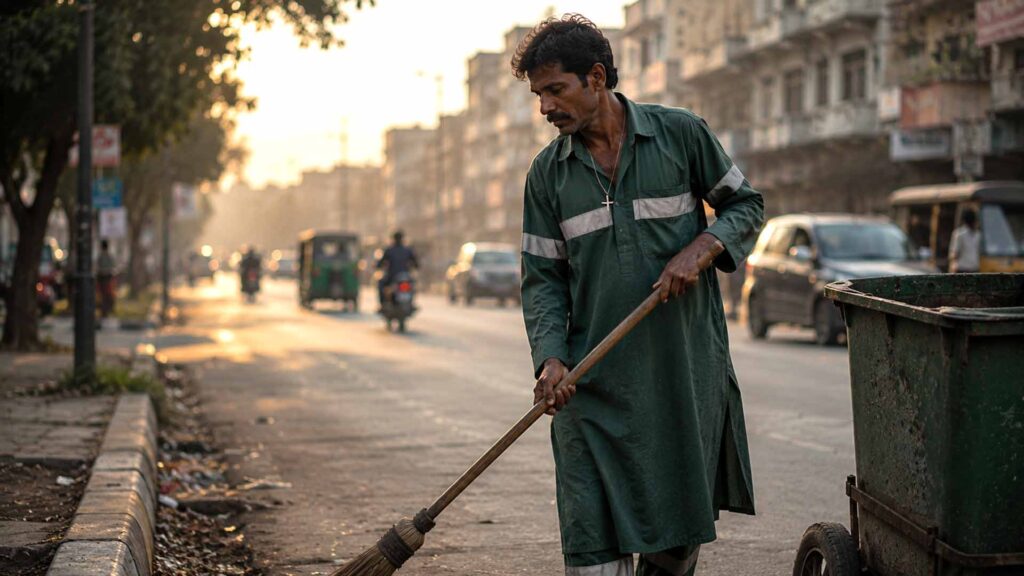
Pakistan’s own National Commission for Human Rights investigated discriminatory job advertisements and found that more than 300 government and private-sector organisations had published advertisements containing discriminatory requirements affecting minorities.
A recurring practice involved sanitation posts specifying Christians or non-Muslims.
This practice carries an ugly historical legacy.
Christians have long been disproportionately associated with sanitation and other low-status work in Pakistan.
The NCHR has described this as systemic discrimination.
Think again about the flag.
One quarter is white because minorities were important enough to be represented in the national symbol.
Yet generations later, the religion represented by that white stripe has sometimes appeared in job advertisements not because Christian applicants were being recruited for leadership—
but because they were being recruited to clean sewers and streets.
There is nothing dishonourable about sanitation work.
The injustice lies in assigning socially stigmatised work to a community because of religion.
Economic Inequality Makes Religious Vulnerability Worse
Pakistan’s National Commission for Human Rights has acknowledged that Christian and Hindu minorities experience social discrimination, violence and unequal access to educational and employment opportunities.
Its Jaranwala investigation also drew attention to the disproportionate representation of Christians in bonded and low-paid labour.
That matters because poverty changes the consequences of persecution.
A wealthy family receiving threats may be able to relocate.
A poor Christian brick-kiln worker may not.
A wealthy defendant may hire experienced lawyers.
A sanitation worker may depend entirely on outside legal assistance.
A family with international connections may leave the country.
A daily-wage family may not even be able to leave the district.
Equality on a flag therefore needs economic reality behind it.

Christian Children and the Question of Belonging
The promise represented by the white stripe also reaches into schools.
If minority children truly belong to Pakistan, the education system should teach them that they belong.
Yet studies of Pakistani education have repeatedly raised concerns about religious bias and the representation of minorities.
When Christian children experience humiliation or are taught national identity primarily through majority religious identity, they may receive a very different message from the one contained in the flag.
The flag tells them:
There is a place for you.
Discrimination tells them:
Know your place.
Those are not the same promise.
Churches Can Be Protected—And Still Be Vulnerable
Pakistan has taken protective measures around churches at various times, especially following terrorist attacks.
Muslim police officers have guarded Christian worshippers.
Government officials have condemned attacks.
Muslim neighbours have sometimes protected Christian families.
These facts matter and deserve recognition.
Pakistan’s story is not simply a story of Muslims persecuting Christians.
There are countless examples of solidarity.
But the repeated need for extraordinary security around Christian worship also demonstrates the vulnerability that exists.
A Christian going to church should not need armed protection simply because attending worship makes them a possible target.
The white stripe should represent the ability to worship openly and safely—not merely the promise that police may arrive after a threat occurs.
Society Has Also Failed the Promise
Government is only part of the story.
Minorities experience society directly.
A law can prohibit discrimination while a neighbour still uses a degrading word.
A constitution can protect freedom of religion while an employer refuses a Christian applicant.
A police officer can guard a church while another person treats a Christian as socially inferior.
A government can reconstruct a damaged church while prejudice continues in the neighbourhood around it.
Pakistan’s National Commission for Human Rights itself has acknowledged that religious minorities experience direct and indirect discrimination in everyday life.
This means the promise of the white stripe cannot be fulfilled by government alone.
Pakistani society must fulfil it too.
But Pakistan Has Not Failed in Every Respect
A fair assessment must recognise progress as well as failure.
Pakistan has minority parliamentarians.
It maintains constitutional protections for freedom of religion.
It created a National Commission for Human Rights that has itself investigated discrimination against minorities.
Government institutions have challenged discriminatory employment advertisements.
Police have sometimes successfully prevented mob violence.
Governments have reconstructed churches after attacks.
Pakistani judges have acquitted people wrongly convicted in blasphemy cases.
Muslim lawyers and human-rights activists have defended Christian defendants.
Ordinary Muslim Pakistanis have hidden Christian neighbours from mobs and defended places of worship.
Government leaders regularly use National Minorities Day to reaffirm the principle of equal citizenship and invoke Jinnah’s 11 August vision.
These examples matter.
To say that Pakistan has not fully honoured the promise of the white stripe is not the same as claiming that Pakistan has done nothing for minorities.
That would be inaccurate.
The real question is whether protection has become sufficiently reliable that a minority citizen can expect equality as a right rather than experience it as an occasional act of goodwill.
The Difference Between Protection and Equality
There is a subtle but important distinction.
A government can protect minorities while still treating them as minorities requiring special protection.
Equal citizenship means something more.
It means a Christian should not have to ask:
Will police protect my church this Sunday?
Will my religion prevent me from getting this job?
Will my child be mocked at school?
Could an accusation against one Christian bring a mob to our neighbourhood?
Can I become the leader of my own country?
Will authorities protect me before violence occurs—or compensate me afterwards?
True equality exists when such questions become unnecessary.
Is the White Stripe a Gift From the Majority?
It should not be understood that way.
The white stripe does not mean:
Pakistan generously allows minorities to live here.
Christians, Hindus, Sikhs, Parsis and other communities are not guests to whom the Muslim majority lends a small portion of the national flag.
They are citizens.
Many of these communities existed in the territory that became Pakistan long before Pakistan itself existed.
Their presence is older than the flag.
The white stripe therefore should not represent charity.
It should represent belonging.
Christians Did Not Arrive After Pakistan
Christian communities were already present when Pakistan was created.
They worked in education.
Healthcare.
Public administration.
Military service.
Agriculture.
Labour.
Politics.
They helped build institutions of the new country.
The white stripe did not predict that minorities might someday arrive.
It recognised citizens who were already there.
That historical reality matters when Christians are sometimes treated socially as outsiders.
They are not outsiders.
They are part of Pakistan’s story.
Why One Quarter of the Flag Matters
Today, Pakistan’s non-Muslim population is considerably smaller proportionally than the white portion of the flag.
But in 1947, Liaquat Ali Khan explained that the white portion was approximately one quarter and connected it with the minority population and with room for minorities within the new state. Contemporary reporting of the Constituent Assembly debate preserves that symbolism.
The important point is not to treat the flag as a demographic chart.
National flags do not require redesign whenever census percentages change.
The white portion represents a principle.
Even if only one non-Muslim citizen remained in Pakistan, that citizen would still deserve equal protection under the law.
Rights are not proportional to population.
What Would Fulfilling the White Stripe Actually Mean?
If Pakistan wanted to fulfil the promise represented by the white portion of its flag completely, what would that look like?
It would mean that no Pakistani job advertisement associated Christianity with sanitation work.
It would mean that Christian children learned that their religion made them no less Pakistani.
It would mean that allegations of blasphemy were investigated before crowds could turn accusations into punishment.
It would mean police arrived before churches were burned.
It would mean perpetrators of communal violence faced credible accountability.
It would mean poor minority workers possessed real economic alternatives.
It would mean women and girls from minority communities had effective protection from coercion.
It would mean citizens could change religion without fearing death.
It would mean Christians, Hindus, Sikhs and other non-Muslims were eligible for the highest offices of their own country.
And it would mean that no citizen needed to hide religious identity in order to feel safe.
That would transform the white stripe from symbolism into lived citizenship.
Has Pakistan Fulfilled the Promise?
After nearly eight decades, the fairest answer is:
Not fully.
The promise has not disappeared.
Pakistan still officially recognises minority rights.
Its flag still contains the white stripe.
Its Constitution contains important protections.
State institutions have at times intervened on behalf of minorities.
Pakistani Muslims have repeatedly defended Christian neighbours and other minorities.
Progress has occurred.
But substantial evidence from Pakistan’s own National Commission for Human Rights, as well as international human-rights organisations, shows that religious minorities continue to face discrimination, unequal economic opportunities, religiously motivated violence and insecurity.
Human Rights Watch has documented failures of protection in attacks on Christian settlements.
The NCHR has documented discriminatory employment practices.
And blasphemy laws and allegations continue to pose serious risks, particularly for vulnerable religious communities. USCIRF reiterated these concerns in late 2025.
The white stripe remains.
The promise remains.
Its complete fulfilment remains unfinished.
The White Stripe Should Not Be Removed—Its Promise Should Be Realised
The answer to the failure of minority protection is not to regard the white stripe as meaningless.
Quite the opposite.
Pakistan should take it more seriously.
Every time the national flag is raised, the green and white rise together.
The green cannot remain on the flag while the white is removed.
Perhaps that visual reality contains the most important lesson.
Pakistan does not need to choose between its Muslim majority and its religious minorities.
Both are already represented in the same flag.
The flag does not show a Pakistan where one must disappear for the other to exist.
It shows them together.
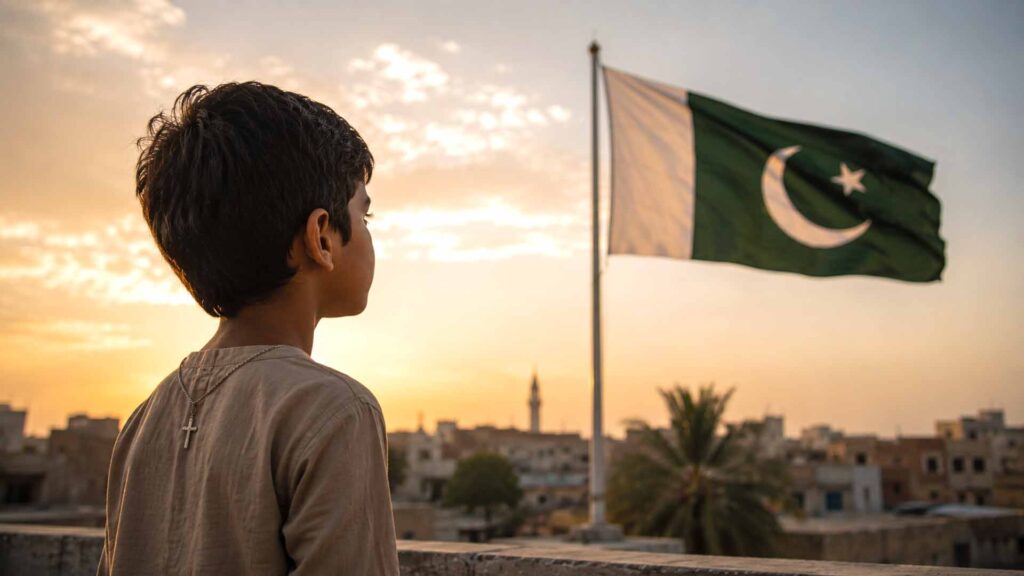
A Message to Pakistan’s Christian Children
A Christian child in Lahore, Faisalabad, Karachi, Islamabad, Quetta or a small Punjab village may look at Pakistan’s flag and see mostly green.
But there is also white.
That white is not an empty space.
It represents them.
It tells that child:
Pakistan is your country too.
Not because somebody tolerates you.
Not because a politician grants you permission.
Not because the majority has decided to be generous.
But because you are a citizen.
The tragedy begins when the child sees the white stripe on the flag but does not experience its meaning in everyday life.
Conclusion: The Unfinished Promise of the White Stripe
Pakistan’s national flag contains one of the most beautiful expressions of minority inclusion imaginable.
The Muslim majority occupies the green.
Religious minorities occupy the white.
Different colours.
One flag.
One country.
The symbolism is simple.
Living up to it has proven considerably more difficult.
On 11 August 1947, Pakistan’s Constituent Assembly adopted the national flag. Liaquat Ali Khan explained that the white portion provided a place for minorities. On that same historic day, Muhammad Ali Jinnah told the Assembly that Pakistan was beginning with the fundamental principle that its people were equal citizens of one state.
Almost eight decades later, those two events can still be read together.
The white stripe was recognition.
Jinnah’s words were a principle.
History became the test.
Pakistan has undoubtedly produced examples of minority participation, solidarity, legal protection and progress.
But it has also produced Joseph Colony.
Jaranwala.
Blasphemy prosecutions.
Discriminatory employment advertisements.
Attacks on churches.
Social exclusion.
And constitutional distinctions based explicitly on religion.
These realities prevent an honest observer from saying that the promise represented by the white stripe has been completely fulfilled.
But an unfulfilled promise is not necessarily a dead promise.
Pakistan can still choose to honour it more fully.
The purpose of raising these issues should not be to insult Pakistan’s national flag.
It should be exactly the opposite:
to ask Pakistan to live up to what its flag already says.
The white stripe does not ask the Muslim majority to surrender its identity.
The green remains.
It does not ask Pakistan to erase Islam from its history.
The crescent and star remain.
It asks only that the citizens represented by the white portion be able to look at their national flag and recognise their actual lives within it.
A Christian should see the white stripe and think:
I am safe here.
A Hindu should see it and think:
I am equal here.
A Sikh should see it and think:
I belong here.
Every minority child should be able to look at Pakistan’s flag and say:
That part represents me—and my country treats me as though it does.
Until that day, the white stripe remains more than a national symbol.
It remains an unfinished promise.
Editorial Note
This article does not suggest that every Pakistani Muslim discriminates against religious minorities or that every Pakistani institution has failed them. Pakistan has many officials, judges, police officers, lawyers, activists, religious leaders and ordinary citizens who have defended minority rights and opposed religious violence.
The article asks a narrower question: whether the ideal of equal minority belonging symbolised by the white portion of Pakistan’s national flag has been fully realised in law and everyday life.
Available evidence indicates that significant gaps remain.
Read in Dutch | German | Italian | Portuguese